


Traffic through the critical Strait of Hormuz remained at a trickle on the second day of a fragile two-week ceasefire, with only a handful of vessels daring to test Iran's newly imposed navigation protocols while major shipping lines continue to hold back pending security assurances.
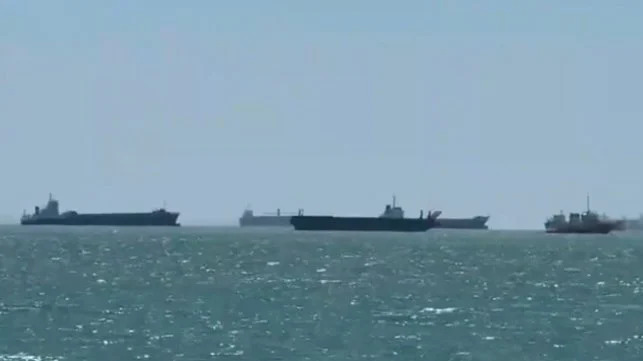
The White House maintains that the Strait is open, but Iran has moved swiftly to consolidate control over the vital shipping lane, announcing a new Traffic Separation Scheme that requires vessels to navigate prescribed routes under Iranian supervision. So far, only seven ships have made the transit in the first 24 hours—six bulk carriers and one small product tanker—with most coming from countries such as India that had pre-existing agreements with Iran for safe passage.
None of the tankers trapped in the Persian Gulf has yet attempted the transit, including three Chinese tankers that appeared to be queuing but remained stationary while continuing to transmit AIS signals highlighting their Chinese ownership and crew. A Saudi tanker also moved into a holding position following reports of renewed diplomatic contact between Saudi and Iranian officials.
All signs point to no meaningful rebound in traffic, with Reuters concluding volumes remain at approximately 10 percent of pre-war levels. Maritime intelligence firm Kpler estimates that 180 tankers loaded with approximately 172 million barrels of crude oil and refined products remain stranded in the Gulf, while some estimates suggest more than 400 laden crude oil tankers plus LNG and LPG carriers are waiting for safe passage.
"There will be no return to the pre-war status quo," an unnamed Iranian official told Russian news agency TASS, revealing that fewer than 15 ships per day are permitted to transit under current ceasefire terms—strictly contingent upon Iran's approval and enforcement of specific protocols.
The International Maritime Organization has begun pushing back against Iran's rumored plans to impose transit fees. "There is no international agreement where tolls can be introduced for transiting international straits. Any such toll will set a dangerous precedent," an IMO spokesperson told Reuters, citing international agreements guaranteeing the right of transit through international straits.
Major carriers remain cautious. Maersk, Hapag-Lloyd, and NYK have stated they are watching and waiting for security assurances, while Mitsui O.S.K. Lines CEO said the company is looking to ensure safety risks are sufficiently low and seeking guidance from the Japanese government before resuming operations.
Maritime AI intelligence firm Windward noted that the first 48 hours of the ceasefire would be critical to shipowners' willingness to enter the Strait—a window that appears to be closing with minimal vessel movement.
Even if traffic gradually resumes, analysts warn of a prolonged recovery period. Hapag-Lloyd told Reuters it would take weeks, if not months, to restore shipping schedules. Xeneta analyst Peter Sand noted that the conflict displaced 250,000 TEU of weekly shipping capacity and called the two-week ceasefire "a very short window of opportunity," while warning there is no guarantee it will hold.
The standoff underscores the fragility of global energy supply chains and the potential for lasting disruption even as diplomatic efforts continue behind the scenes.